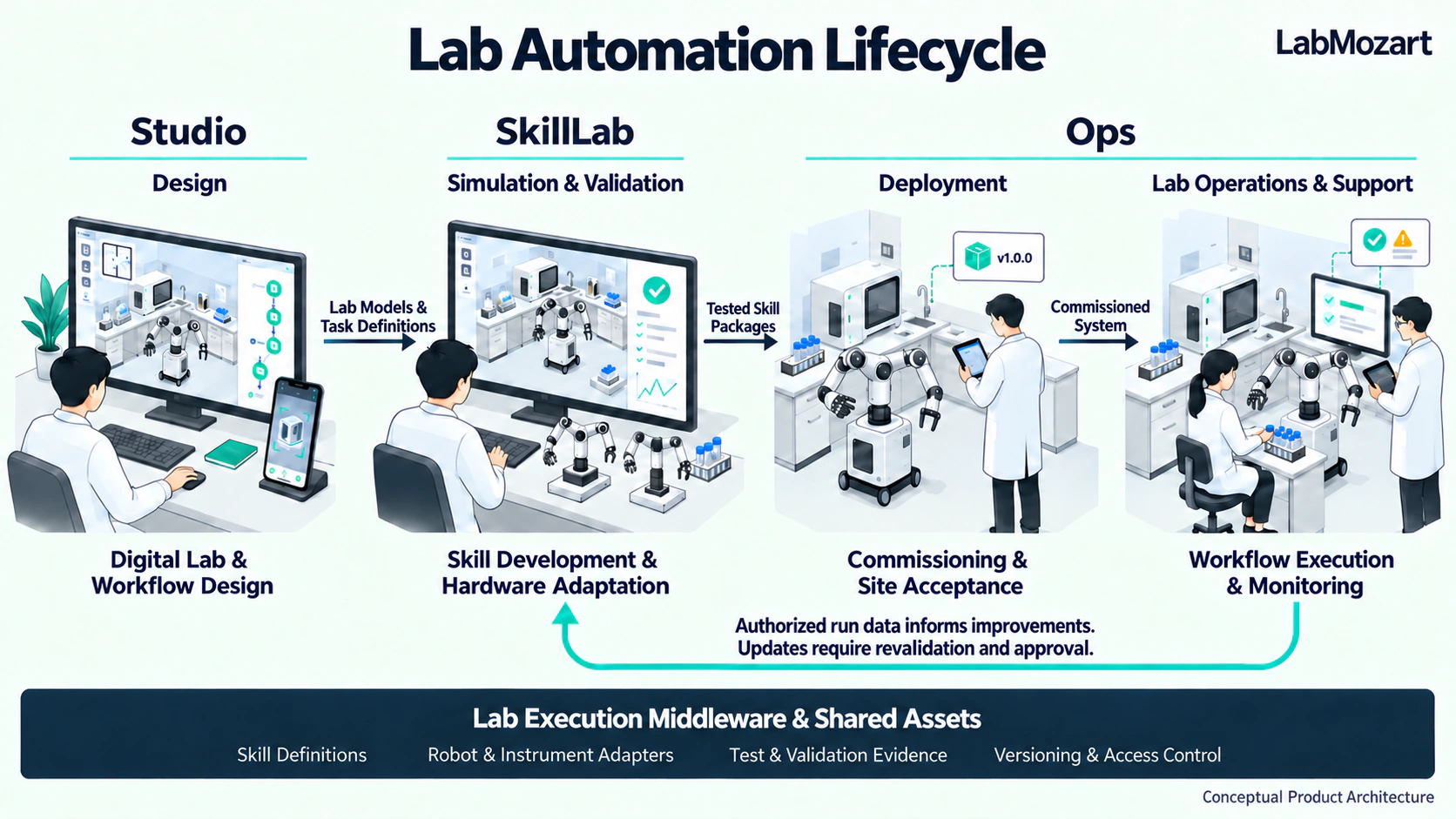
Develop candidates; learn from feedback
AI researches methods, generates skill code and configurations, uses simulation to test geometry, contact and forces, and analyzes failures. Failed candidates return to development.
Authorized execution records link tasks, configurations, versions and outcomes. AI uses them to distinguish perception, calibration, contact, policy and experimental factors, then updates code, configurations, tests and development rules.
Operations, exceptions and human corrections linked to outcomes refine skill applicability, recovery strategies and interfaces. Object specifications, interfaces, calibration and site records refine adaptation configurations and their applicability. QC, controls and cross-configuration records build regression sets and validation matrices.
Contamination requires dedicated QC; causal conclusions require controlled experiments. Align units, coordinate frames, time and object semantics. Retain provenance, calibration, configuration, versions and missing information; distinguish measured, inferred and simulated parameters.
Evaluate independently; measure reuse
Compare learned policies and other methods with reliable baselines on the same tasks and resource budgets in independent tests, retaining failures. Assess reuse through version differences, execution logs and engineering time for adaptation and revalidation, while checking human intervention and experimental quality.
Release gate: continue analyzing candidates that fail criteria. Independent evaluation, necessary revalidation and approval produce traceable versions for subsequent tasks or authorized updates. Active versions are not automatically replaced.